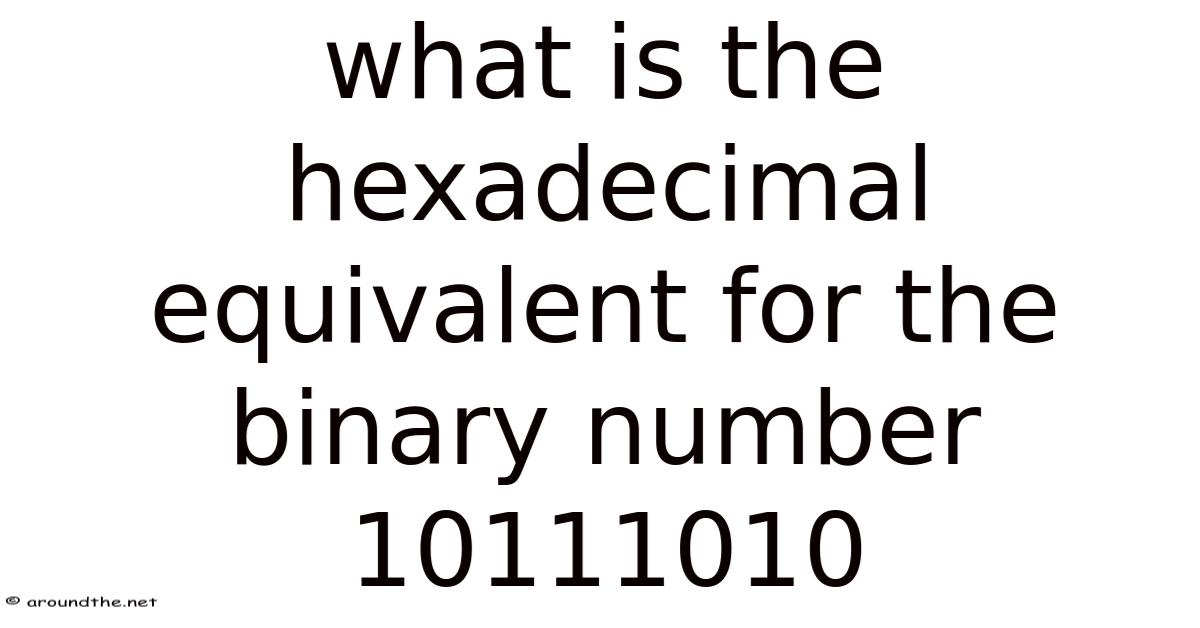
What’s the Hex Equivalent of Binary 10111010?
Let’s cut right to the chase: if you’re staring at the binary number 10111010 and wondering what it means in hexadecimal, you’re not alone. Even so, this kind of conversion pops up everywhere in computing—from debugging code to understanding memory addresses. And honestly, once you get the hang of it, it’s not as intimidating as it looks.
So what’s the answer? Still, BA in hex. But how do we get there? Let’s unpack this properly That's the part that actually makes a difference..
What Is Hexadecimal and Binary?
Binary is the language of computers. It’s made up of just two digits—0 and 1—and represents everything from numbers to images to the apps on your phone. Plus, each digit in a binary number is a power of two, starting from the rightmost bit. That means the rightmost digit is 1 (2^0), then 2 (2^1), then 4 (2^2), and so on.
Hexadecimal, or hex, is base-16. So hex digits go from 0–9, then A, B, C, D, E, F. This system is a shorthand for binary because each hex digit corresponds to exactly four bits. Instead of stopping at 9, it uses letters A through F to represent values 10 through 15. That makes it way easier for humans to read long binary strings without losing their minds.
Why Four Bits?
Because 2^4 = 16. Each group of four binary digits can represent one hex digit. This is the key to converting between the two.
Why Does This Conversion Matter?
Understanding how to switch between binary and hex isn’t just academic—it’s practical. Still, programmers use hex to represent memory addresses, color codes in web design, and machine-level data. That said, if you’ve ever seen something like #FF5733 in CSS, that’s hex. And behind the scenes, your computer is crunching binary.
When developers debug, they often look at memory dumps or binary logs. Converting those to hex gives them a more readable format. Miss this step, and you’re stuck counting ones and zeros like it’s 1982 Small thing, real impact..
How to Convert Binary 10111010 to Hexadecimal
Let’s walk through converting 10111010 to hex step by step.
Step 1: Split Into Nibbles
Start by breaking the binary number into groups of four bits, starting from the right. If the leftmost group has fewer than four bits, add leading zeros Easy to understand, harder to ignore. Practical, not theoretical..
So, 10111010 becomes:
- 1011 | 1010
Step 2: Convert Each Nibble to Decimal
Now, convert each group to its decimal equivalent.
-
1011:
1×2³ + 0×2² + 1×2¹ + 1×2⁰ = 8 + 0 + 2 + 1 = 11
In hex, 11 is B That alone is useful.. -
1010:
1×2³ + 0×2² + 1×2¹ + 0×2⁰ = 8 + 0 + 2 + 0 = 10
In hex, 10 is A.
Step 3: Combine the Hex Digits
Put the hex digits together in the same order as the nibbles. That gives us BA.
So, 10111010 in binary equals BA in hexadecimal.
Common Mistakes People Make
Here’s where things can go sideways if you’re not careful.
First, forgetting to split into nibbles correctly. If you start grouping from the left instead of the right, you’ll end up with the wrong hex digits. Always start from the right.
Second, mixing up the order. Practically speaking, once you’ve converted each nibble, keep them in the same sequence. Reversing them is a classic error Which is the point..
Third, not accounting for incomplete nibbles. Still, if your binary number doesn’t divide evenly into groups of four, you need to pad with leading zeros. As an example, 1101 becomes 0000 1101, which converts to 0D in hex.
And finally, confusing hex letters with decimal values. That's why remember, A is 10, B is 11, and so on. Mixing this up leads to incorrect conversions.
Practical Tips for Binary to Hex Conversion
Here’s how to make this process smoother That's the part that actually makes a difference..
- Use a calculator: Many scientific calculators have a binary to hex function. But don’t rely on it blindly—understand the steps first.
- Practice with smaller numbers: Start with 8-bit binaries like 11110000 (which is F0) before tackling longer strings.
- Memorize common patterns: Knowing that 1111 is F or 1010 is A speeds things up.
- Double-check your work: Convert back from hex to binary to verify. BA in hex is 10111010 in binary—perfect match.
And if you’re doing this by hand, write it out. Seeing the nibbles visually helps avoid mistakes Small thing, real impact. Surprisingly effective..
FAQ
How do I convert binary to hexadecimal?
Split the binary into groups of four bits from the right, convert each group to decimal, then map those decimals to hex digits (0–9, A–F).
What is the decimal equivalent of 10111010?
That’s 186 in decimal. (1×128 + 0×64 + 1×32 + 1×16 + 1×8 + 0×4 + 1×2 + 0×1 = 186)
Can I convert hex to binary the same way?
Yes. Each hex digit converts to four bits. Take this: BA becomes 1011 1010.
**Why
Why is hexadecimal used in computing?
Hexadecimal is a more compact way to represent binary data. Since each hex digit corresponds to four binary digits, it's easier to read and write long binary numbers. Take this: a single byte (8 bits) can be written as two hex digits instead of eight binary digits. This shorthand reduces errors and speeds up communication between humans and systems That's the part that actually makes a difference. Turns out it matters..
The Bigger Picture: Why This Matters
Binary-to-hexadecimal conversion isn’t just an academic exercise—it’s foundational to how computers work. Every piece of data on your device, from a simple text file to a complex video, is ultimately stored as binary. Hexadecimal acts as a bridge between the raw 1s and 0s and the human-readable formats we interact with daily But it adds up..
For programmers, understanding hex is essential for tasks like debugging memory addresses or working with low-level code. Network engineers rely on it to interpret IP addresses and data packets. Even in cybersecurity, hexadecimal notation is used to describe encryption keys and malware signatures.
But beyond its technical utility, mastering this conversion sharpens your ability to think in different number systems—a skill that’s invaluable in fields like computer science, engineering, and data analysis. It trains you to break down complex problems into manageable chunks, much like how we split binary into nibbles to simplify hex conversion.
Not the most exciting part, but easily the most useful It's one of those things that adds up..
Final Thoughts
Don’t let binary and hexadecimal conversions intimidate you. With practice, they’ll become second nature. Start small, use the steps outlined here, and remember: every expert was once a beginner. The key is consistency and patience.
So the
next time you see a string like 10111010, you won’t see chaos—you’ll see BA. You’ll see structure. You’ll see the language of machines, translated Less friction, more output..
Keep a cheat sheet handy if you need to. Convert a few addresses from your network settings or a color code from a stylesheet. Still, scribble nibbles on scrap paper. Real-world practice beats rote memorization every time.
And when you inevitably hit a snag—maybe a leading zero gets dropped or a nibble gets misaligned—don’t get frustrated. That’s not failure; that’s calibration. Every mistake teaches you where the edges are Small thing, real impact..
Binary and hexadecimal aren’t just notation. They’re a lens. Once you learn to look through it, the invisible architecture of computing comes into focus.
So keep converting. Keep questioning. And most importantly, keep going.
The machine speaks in bits. Now, so do you.
A Practical Next Step
If you want to make this skill stick, try converting the hex color #FF5733 back into binary tonight. In practice, you’ll find it breaks neatly into three bytes—each a pair of hex digits mapping to eight bits—and suddenly CSS stop looking like magic and start looking like math you control. That small exercise closes the loop between theory and the tools you already use.
Conclusion
Hexadecimal is not a replacement for binary, but a translation layer that makes the machine’s native tongue survivable for human minds. Whether you’re tracing a bug, reading a memory dump, or just curious how a screen knows what red looks like, the ability to move between base‑2 and base‑16 is a quiet superpower. By grouping bits into nibbles and nibbles into digits, we trade noise for clarity without losing a single ounce of meaning. Learn the pattern, practice the mapping, and the gap between human and hardware gets a little smaller every time.
