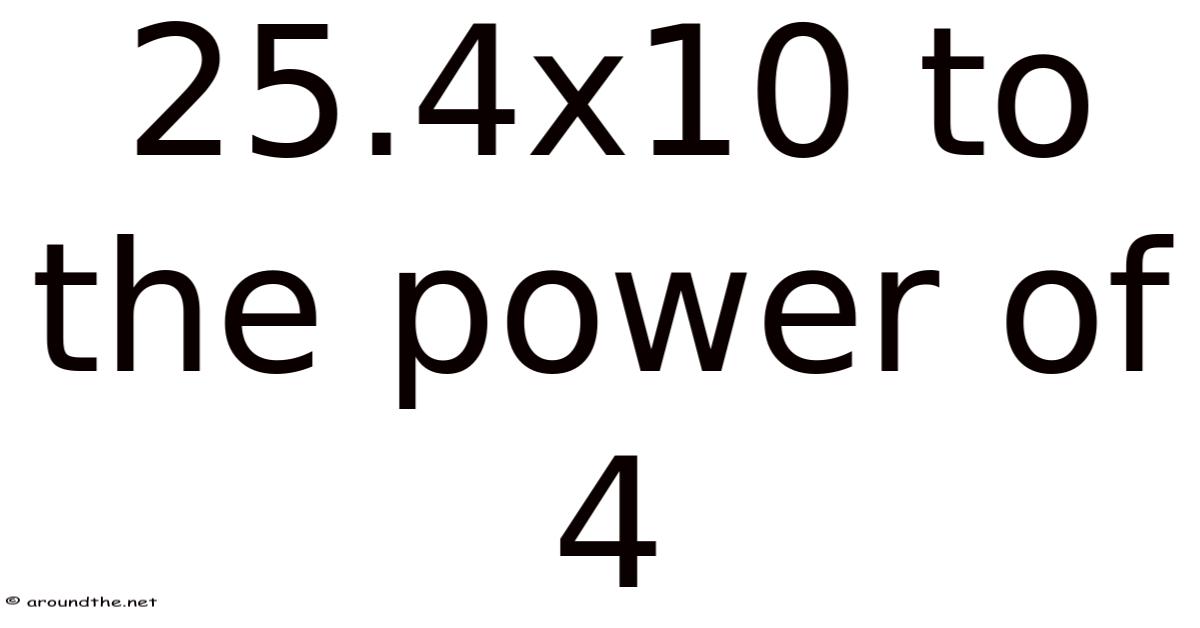
Ever stared at a number like 25.Here's the thing — 4x10 to the power of 4 and felt your brain quietly check out? You're not alone. It looks like the kind of thing locked inside a physics textbook or scrawled on the margin of an engineer's notebook.
But here's the thing — that string of digits and symbols is just a way of writing something big without writing out all the zeros. Even so, once you see what it's actually doing, it stops being intimidating. And honestly, it shows up in more real-life places than you'd expect.
Counterintuitive, but true And that's really what it comes down to..
What Is 25.4x10 to the Power of 4
Let's rip the bandage off. 4 × 10 × 10 × 10 × 10. Plus, 4x10 to the power of 4 means 25. Think about it: 25. That said, in plain math, that's 25. 4 multiplied by 10 four times over. Still, each time you multiply by 10, the decimal jumps one place to the right. Do it four times and you've got 254,000 Turns out it matters..
So the short version is: 25.Plus, 4x10 to the power of 4 equals 254,000. Not a trick. Not a code. Just a compact way to say a quarter of a million plus a bit No workaround needed..
Why Write It That Way
You might ask — why not just say 254,000? Writing 25.In science and engineering, you often start with a measured number like 25.Also, the reason is context. In real terms, 4 (which, fun fact, is the exact number of millimeters in one inch). Then you need to scale it. Think about it: fair question. 4 × 10⁴ keeps the original coefficient visible, so you know where the number came from.
You'll probably want to bookmark this section.
Scientific Notation vs Engineering Notation
This is where most people get confused. So naturally, our friend 25. Scientific notation wants one non-zero digit before the decimal: 2.Engineering notation lets the exponent be a multiple of three and keeps the leading number as-is: 254 × 10³. 54 × 10⁵. 4x10 to the power of 4 sits between those worlds — it's a scaled form, common in technical fields but not strictly "scientific" by textbook rules.
Why It Matters / Why People Care
Why does this matter? 4 nm, they're off by a factor of ten thousand. That part won't fit. Day to day, if someone drops the exponent and reads 25. Because of that, 4x10 to the power of 4 nanometers. Because misreading a scaled number can cost real money, or worse, real safety. That said, imagine a machining spec that says a tolerance is 25. That bridge might crack.
Turns out, this kind of notation is how we keep big and small numbers readable. Think about it: without it, we'd be drowning in zeros. And in practice, the people who understand these formats catch errors faster. They trust the data more because they know what the data is actually saying.
It also matters for anyone learning math or working across units. 4 is a bridge between imperial and metric. Worth adding: the number 25. Pair it with a power of ten and you've got a fast conversion tool hiding in plain sight.
How It Works (or How to Do It)
Breaking this down isn't hard, but it does deserve care. Also, here's how to handle 25. 4x10 to the power of 4 — or any number in that shape — without second-guessing yourself.
Step 1: Know What the Power Means
The "10 to the power of 4" part is the engine. You're doing 25.Think about it: it means 10⁴ = 10,000. So you're not doing fancy calculus. Consider this: nothing more. 4 × 10,000.
Step 2: Shift the Decimal
Take 25.4. That said, multiply by 10 once → 254. (decimal moved right one)
Twice → 2,540.
Three times → 25,400.
Four times → 254,000.
That's it. You can do it in your head if you trust the process. I know it sounds simple — but it's easy to miss a place value under pressure.
Step 3: Keep the Coefficient Honest
If you're converting to proper scientific notation, you'd rewrite 254,000 as 2.54 × 10⁵. The value hasn't changed. And you've just dressed it differently. The coefficient (the 25.4 or 2.54) tells you the precision of the original measurement. Don't chop it without reason Simple as that..
Step 4: Watch the Units
25.4 mm per inch × 10⁴ = 254,000 mm. Divide by 1,000 and that's 254 meters. So 25.4x10 to the power of 4 millimeters is 254 meters. Real talk — always carry the unit in your head or on the page. A bare number is a story with no context That's the whole idea..
Step 5: Reverse It When Needed
Given 254,000 and told it came from 25.4 × 10ⁿ, just count decimal shifts back to 25.On the flip side, 4. And from 254,000 to 25. That said, 4 is four places left. So n = 4. That reverse skill is what separates people who "use" math from people who understand it.
Common Mistakes / What Most People Get Wrong
Honestly, this is the part most guides get wrong — they treat the format as trivial and skip the habits that prevent errors.
One big mistake: confusing 10⁴ with 10 × 4. Worth adding: it isn't 40. Now, it's 10,000. I've seen bright students lose points because they added instead of multiplied exponentially. The notation is a shorthand for repeated multiplication, not addition Not complicated — just consistent. Nothing fancy..
Another: dropping the coefficient's precision. In practice, rounding to 25 × 10⁴ loses a half percent. 4 matters. If a sensor reads 25.Sounds tiny. 4x10 to the power of 4, that .But in a circuit or a dosage, half a percent is not nothing.
And here's what most people miss — they think the "x10 to the power of" is just decoration. Practically speaking, it's not. It's the scale. Change the 4 to a 3 and you've got 25,400 instead of 254,000. One character, tenfold difference.
Finally, folks mix up notation systems. They see 25.4 × 10⁴ and "correct" it to 2.But 54 × 10⁵ without checking if the field they're in prefers engineering notation. Plus, both are right. But switching silently can confuse a teammate who expected the original form.
Practical Tips / What Actually Works
Want to actually get comfortable with numbers like this? Here's what works in the real world.
- Write the expansion once. Seriously. The first time you meet a format, write 25.4 × 10 × 10 × 10 × 10 = 254,000. Your brain locks it in faster than memorizing a rule.
- Use the unit bridge. Since 25.4 mm = 1 inch, any 25.4 × 10ⁿ is a conversion waiting to happen. Keep that fact in your back pocket.
- Say it out loud. "Twenty-five point four times ten to the fourth." The rhythm helps. Sounds dumb. Works great.
- Check with scientific notation. If you're unsure, convert to 2.54 × 10⁵ and back. Two paths, same answer, more confidence.
- Don't trust the calculator alone. Punch 25.4 * 10^4 and verify the decimal shift matches your mental model. Build the muscle, not just the dependency.
Worth knowing: most spreadsheet tools will show 2.Which means that "E" is just "× 10^". 54E+05 for this. Same beast, different font Easy to understand, harder to ignore..
FAQ
What is 25.4x10 to the power of 4 in standard form?
It's 254,000. You get there by multiplying 25.4 by 10,000.
Is 25.4 × 10⁴ the same as 2.54 × 10⁵?
Yes, they represent the same value. The first is engineering-style, the second is scientific notation.
Why is 25.4 used so often with powers of ten?
Because 25.4 millimeters equals exactly one inch. It's a standard conversion factor, so scaling it by powers of ten is common in technical
Common Mistakes in Engineering Notation
Even experienced professionals slip up when juggling exponents and coefficients. And 4 × 10³ μm = 25. One frequent error is mishandling unit conversions within scientific notation. 4 × 10³ micrometers to meters requires adjusting both the coefficient and exponent: 25.4 × 10³ m. Here's the thing — 4 × 10⁻³ m, not 25. Take this case: converting 25.The exponent shifts by six places to account for the micro-to-base-unit conversion. Missing this step can lead to errors by orders of magnitude.
Another trap is assuming all fields use the same notation. In electronics, you might see 4.7 mΩ), while a physicist might prefer 4700 μΩ. 7 × 10⁻³ for a resistor value (4.Both are correct, but using the wrong form in context can cause confusion. Always confirm the preferred notation system in your discipline or team.
Real-World Applications and Pitfalls
Scientific notation isn’t just academic—it’s critical in fields like aerospace, where miscalculating thrust or fuel efficiency by a factor of ten could doom a mission. Similarly, in pharmaceuticals, a dosage error of 0.Because of that, 5% might seem minor, but for potent drugs, it’s the difference between efficacy and toxicity. Engineers designing circuits must also be precise: a capacitor rated at 22 × 10⁻⁹ F (22 nF) versus 2.2 × 10⁻⁸ F (22 nF) is technically the same, but if someone misreads the exponent during assembly, the result could be catastrophic.
In data science, large datasets often involve numbers in scientific notation. And a misstep in parsing 3. 2 × 10⁸ as 3.2 × 10⁴ could distort statistical models or financial forecasts Worth keeping that in mind..
…and everyday tech. Think about the storage capacity, where a solid‑state drive’s 1 TB is 1 × 10¹² bytes. So a careless typo—writing 1 × 10¹¹ instead—would halve the advertised space, confusing customers and suppliers alike. Even the simplest user‑interface displays rely on proper formatting: a smartphone’s battery life of 3.In practice, 7 × 10⁰ V is displayed as “3. Consider this: 7 V”; mis‑displaying it as “3. 7 × 10⁰ V” could mislead a technician into thinking the unit is millivolts.
How to Build Confidence with Scientific Notation
| Step | What to Do | Why It Helps |
|---|---|---|
| 1 | Normalize the coefficient to a number between 1 and 10. Also, | Keeps the notation readable and consistent. Worth adding: |
| 2 | Count the decimal places you move when normalizing. | Translates directly into the exponent. |
| 5 | Peer‑review the notation in collaborative documents. Even so, | Provides an immediate sanity check. |
| 4 | Cross‑validate with a calculator that shows both standard and exponential forms. | |
| 3 | Double‑check the sign of the exponent. | Human eyes catch subtle mistakes that software may overlook. |
You'll probably want to bookmark this section.
Practicing these habits turns scientific notation from a source of anxiety into a second language. Over time, you’ll find that converting between forms—engineering, scientific, or plain decimal—takes less mental effort than the first few months of learning The details matter here. And it works..
Final Words
Scientific notation is more than a mathematical convenience; it is a universal language that bridges disciplines, scales, and units. From the minute dimensions of micro‑electronic components to the vast distances measured by astronomers, it keeps numbers manageable and communication precise.
The key takeaways are:
- Normalize the coefficient to a single‑digit integer (1–9) before adjusting the exponent.
- Keep track of decimal shifts; each move changes the exponent by one.
- Verify with multiple representations—plain decimal, engineering style, and calculator output.
- Mind the context; different fields may favor slightly different conventions.
By mastering these principles, engineers, scientists, and data professionals can avoid costly errors, streamline calculations, and maintain clarity across all projects. Whether you’re drafting a technical report, debugging a circuit, or training a machine‑learning model, a solid grasp of scientific notation will serve you well—making the abstract concrete, the complex simple, and the numbers trustworthy.
